Transformative Architecture: The Reuse and Transformation of an Architectural System across multiple World Expositions Dubai 2020 – Osaka 2025 - Yokohama 2027


General information
-
Home page
https://www.yukonagayama.co.jp/works/104/
-
Location address
World Expositions Dubai 2020 – Osaka 2025 - Yokohama 2027
- Location country
-
Year of construction
2020
-
Year of dismantling
2020
-
Short description of the replacement or dismantling
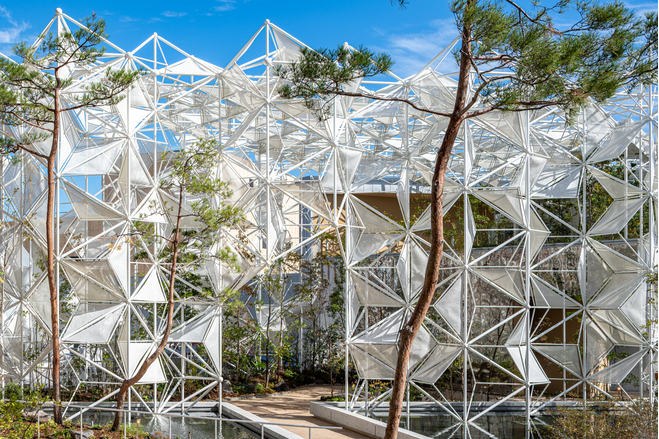
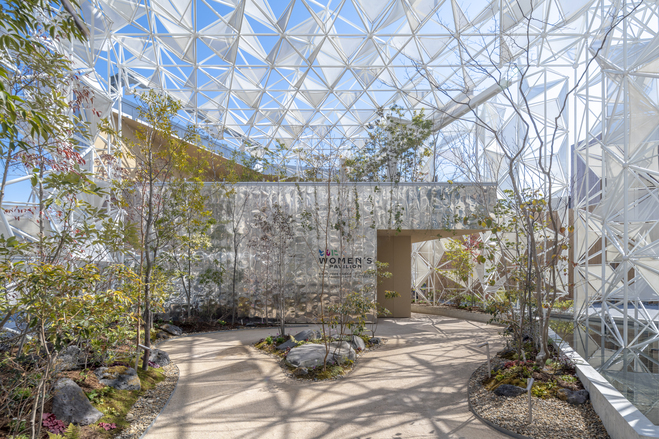
Originally developed for the Japan Pavilion at Expo 2020 Dubai, the facade has been reassembled for the Women’s Pavilion in collaboration with Cartier at Expo 2025 Osaka, Kansai and is currently being repurposed for a third application at the Japan International Horticultural Expo 2027 in Yokohama. The reuse project, termed “transformative architecture”, demonstrates how lightweight ball-joint structures and membrane materials can be reused across different sites, layouts, and scales.
-
Function of building
Exhibition
-
Degree of enclosure
Open structure
-
Number of layers
mono-layer
-
Primary function of the tensile structure
- Daylight gains
- Space defining elements
- Sun protection
Description
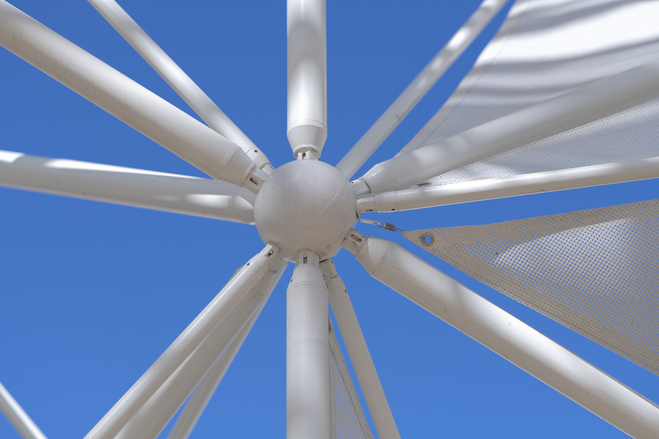
The core architectural element is a three-dimensional geometrical lattice called the KUMIKO facade. The façade design was inspired by the similarity between the traditional Japanese asanoha (hemp leaf) pattern found in Japan's kumiko woodworking technique, and the arabesque in the Middle East. It was constructed using a technique called the ball-joint system. Much like a plastic model kit, this system enables multi-directional connectivity while maintaining structural efficiency through minimal material use.
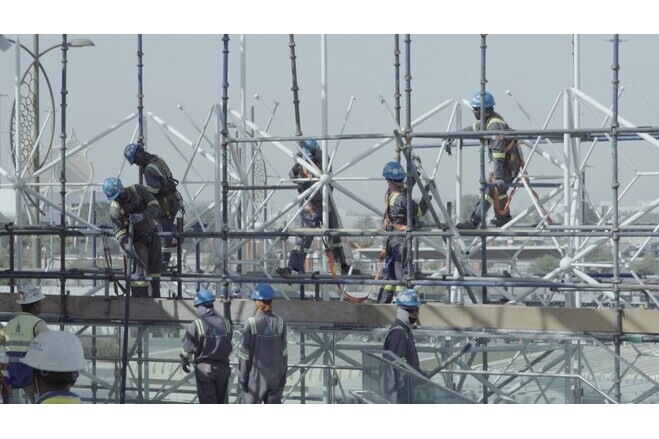
From the outset, the pavilion was conceived as a demountable structure. The ball-joint system allows all primary components—tubes, nodes, and membranes—to be dismantled. This modularity is essential for reuse. The PTFE membrane is selected for its low weight, high tensile strength, ultraviolet resistance, and long-term durability. It also functions as an environmental moderator rather than a sealed enclosure. In Dubai’s hot climate, it filtered intense solar radiation, reduced heat gain, and allowed air movement through the facade. In Osaka too, the membrane unified interior and exterior zones, controlled daylight and glare, supported natural ventilation, and visually integrated diverse spaces.
The technical challenge of reusing the KUMIKO façade in Osaka was reassembling the parts to fit a new site with a completely different footprint. At Dubai, we designed an isosceles triangular building on a large trapezoidal site using Japan's traditional silver ratio. In contrast, the Osaka site allocated for the Women's Pavilion was long and narrow, with a frontage of 18m and a depth of 110m.
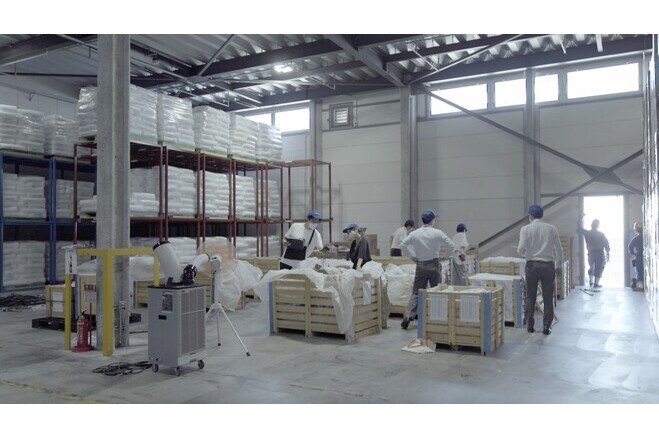
This transformation required extensive digital coordination. In collaboration with ARUP Japan, we conducted extensive structural analyses and spatial simulations to determine how existing components could be placed within the new geometry. Approximately 70% of the original 10.000 components were reused, including both structural components and membranes. Our goal during this process was to solve this difficult puzzle without fabricating new parts. This task alone took us three months. Furthermore, the nodes had unique, individually identified shapes, and the tube wall thickness varied depending on the force distribution. Thanks to Obayashi Corporation's visual process management system, ProMIE, the team was able to sort the parts, ascertain the installation location, and manage the delivery and assembly of materials by attaching a QR code to each part while linking it to the BIM model.
Through this consistent reuse project, we gained the expertise—from design to construction—to not simply relocate a building but to transform it into a different structure tailored to the next site. This knowledge is leveraged for the next reuse project – indoor exhibition shared facilities at the Yokohama GREEN × EXPO 2027. This new facility will be approximately three times the size of the Women's Pavilion, and the KUMIKO facade will have to be reassembled into a completely different form again. This is a yet new challenge for the second reuse project.
Architecture is designed to be rooted in land and intended to remain there permanently; in contrast, Expo architecture exists in place only for six months. In response, we proposed — and have repeatedly realized — a transformative architecture challenging this repeated cycle of "scrap and build" surrounding the World Expo. While the circulation of existing architectural materials is a truly challenging task, we continue to face the challenge with our pavilion, from Dubai to Osaka, and now to the third site, Yokohama. We believe that these transformations were made possible because of the small and simple modules created by the ball-joint system, the technology supporting material circulation, and an increased social awareness and understanding. Through this project and its many transformations, we hope the reuse movement will continue to expand beyond the context of World Expos.
Description of the environmental conditions
Material of the cover
-
Cable-net/Fabric/Hybrid/Foil
Fabric
Main dimensions and form
-
Covered surface (m2)
253
Duration of use
-
Temporary or permanent structure
Temporary
-
Convertible or mobile
Convertible
Involved companies
-
Architects
Yuko Nagayama & Associates
-
Engineers
Ove Arup & Partners Japan
-
Contractors
TRA・K
-
Suppliers
SERGE FERRARI
Editor
-
Editor
Evi Corne