Chemical Research Centre in Venafro




General information
-
Location address
Venafro
-
Location country
Italy
-
Year of construction
1990
-
Short description of the replacement or dismantling
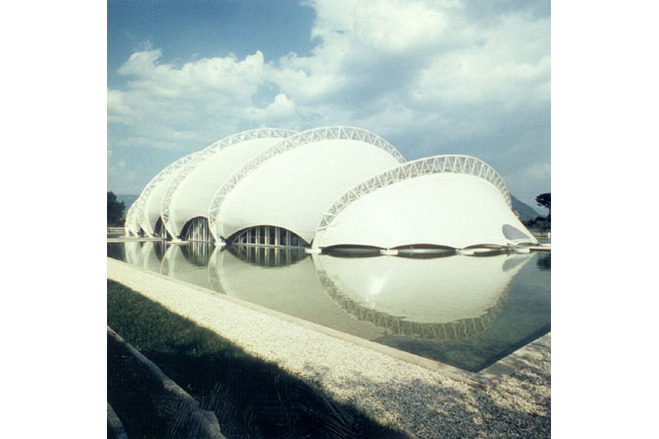
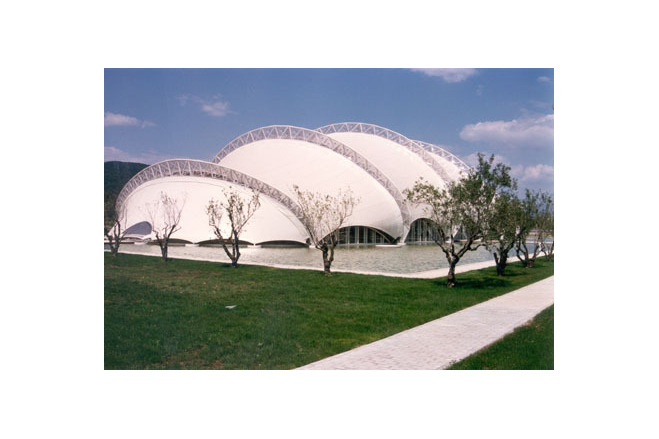
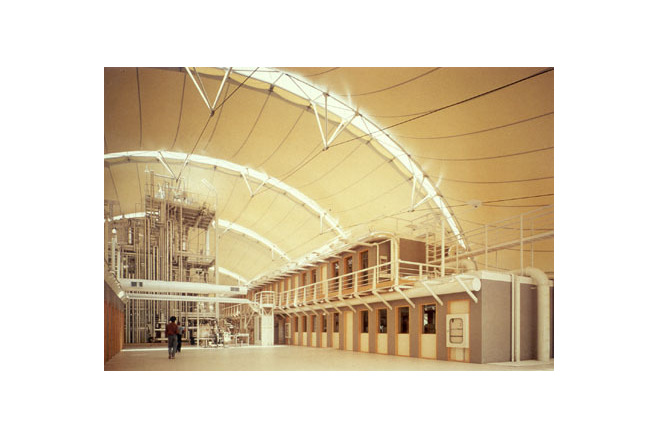
The M&G Ricerche chemical industry research centre in Venafro was designed by Philippe SAMYN and PARTNERS, architects & engineers, and completed in 1991. It is part of an industrial area located in a valley surrounded by hills near Venafro. In the early 1990s, this was one of the first designs in which a membrane structure effectively served as a building with a controlled indoor climate. This meant that it became more than just a sculptural canopy.
The membrane was recently renewed. The renovation was carried out by the original contractor, Canobbio Textile Engineering. After 35 years, this building still has a unique appearance and architectural qualities.
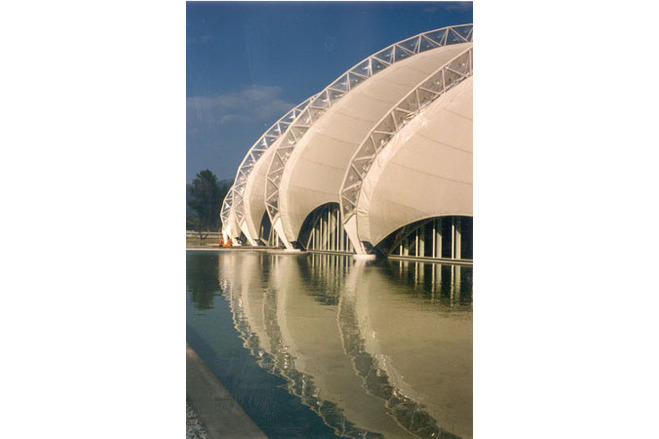
The research laboratory for the chemical industry was housed under one large tent-shaped roof. The programme of requirements included laboratories for heavy experiments as well as for delicate research, supplemented by function-supporting spaces. The plan allowed for the possibility of adjustments to the programme. An optimal shape for the hall led to an elliptical design. The building was also designed with a focus on optimal climate control. Temperatures outside can reach 40°C in summer, while snowstorms can occur in winter. In the original building, the 'cracking' unit generated heat that was beneficial in winter. The oval reflective pool on which the building stands has high thermal regulation properties. In summer, it cools the building by drawing air in from underneath the pool.
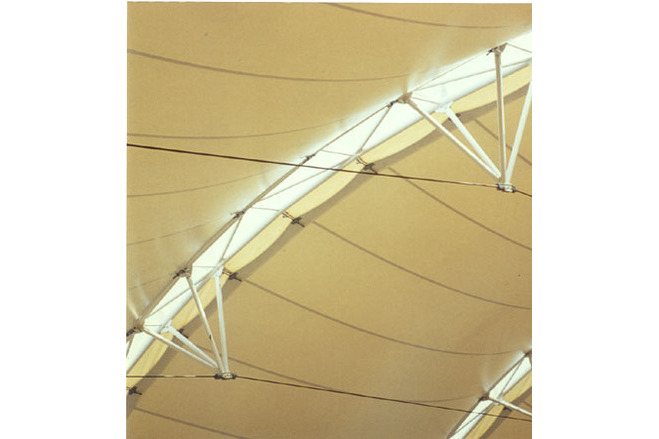
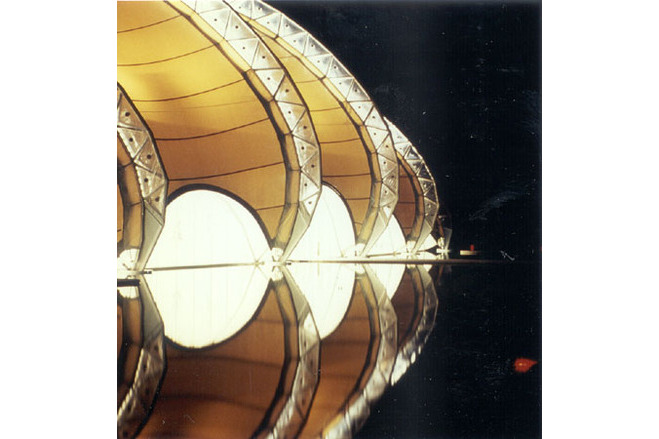
The oval floor plan (85m by 32m) is spanned by six truss arches with a maximum height of 15m. The optimal span for the roof membrane is between 12m and 15m, which determined the number of arches. The triangular cross-section varies along the length of the arch, with maximum dimensions at the top, and taps towards the arch support. The arches are connected to each other by pre-stressed cables. These stabilising cables are connected to the arches via pyramid-shaped supports. Daylight is allowed into the spaces below by a PVC-coated polyester membrane stretched between the arches.
New owner, new function
The tensile structure and the entire surrounding area were acquired several years ago by RES – Recupero Etico Sostenibile, a company operating in the waste recovery sector. Under the existing membrane structure, RES installed a series of laboratories dedicated to material recovery testing and experimentation. Prior to our intervention, the client had already carried out a thorough cleaning and redevelopment of the site, restoring order and operational functionality to the area.
Renovation project
The first phase of the work of Canobbio Textile Engineering involved the replacement of the skylights. The existing membrane was already aged and had undergone modifications over time; therefore, the new skylights had to be designed with an adapted solution compared to the original project. A valance system with an internal tensioned cable was introduced, installed over the existing membrane, as any attempt to weld onto the aged fabric would have been ineffective and technically unreliable. Before installing the new skylights, the steel structure was also repainted and restored, improving both protection and durability.
The following year, after an exceptionally severe storm, the membrane panels - which had already reached the end of their service life - suffered extensive tearing. At that point, a complete replacement of all roof panels became unavoidable. The first step was to return to our historical archives to retrieve the original documentation, construction details, and fixing systems used at the time of the initial installation, including all modifications and improvements introduced over the years.
During the negotiation phase, we emphasized a key differentiating factor: our direct and in-depth knowledge of the original project. It is essential to understand the special fixing details, critical areas and modifications carried out in a structure of this complexity. Entrusting such an intervention to companies that have never operated on the structure represents a tangible technical risk. This awareness, combined with our specific expertise, ultimately led the client to appoint us for the refurbishment.
Once the project was launched, formTL was engaged to design the new roof membrane system (approximately 3.150m²), including arch closure flaps, special lower closure flaps, membrane cable systems, and secondary steelwork. Serge Ferrari 1202 S2 membrane (2,65m roll width) was selected, consistent with the performance and characteristics of the original material. formTL reconstructed the cutting patterns based on the recovered historical data, accurately integrating flap geometries into the cutting models and producing complete workshop drawings, including structural steel details and cable layouts. Throughout this delicate phase, we actively supported and assisted the design process to ensure full coherence with the structural realities of the existing framework.
The execution phase represented the most challenging part of the project. Unlike the original installation in the 1990s - when the space beneath the structure was completely empty - the refurbishment had to be carried out above fully operational laboratories and technical systems. This required extremely careful planning of dismantling and installation operations.
The works were executed by our specialized rope-access team, highly experienced in tensile structures and accustomed to operating at height under complex logistical constraints. A network of webbing straps was installed between arches to allow controlled handling and deployment of the membrane panels. The crane initially planned for installation proved too heavy following ground load verification, requiring a complete reorganization of logistics. A lighter truck-mounted crane and a forklift were used instead, operating simultaneously. Adverse weather conditions further increased the complexity of the installation, yet thanks to the team’s experience and coordination, all panels were successfully installed and tensioned in accordance with the design specifications.
Another delicate aspect concerned the terminal portions of the panels. In the original structure, these elements had been custom-made on site with hinge systems and elastic absorption mechanisms. Replicating the same functional behaviour required testing and on-site adjustments. Furthermore, while the original project had used Crystal material for these terminal parts, the refurbishment opted to use the same membrane as the roof panels, ensuring homogeneous aging performance and improved long-term durability.
Once installation and tensioning were completed, the structure was handed over ready for reopening.
This intervention highlights three key strengths: the ability of Canobbio Textile Engineering to interpret and manage a technically layered and historically complex structure; the rigorous engineering contribution of formTL in reconstructing and optimizing the membrane system; and the high operational competence of the specialized rope-access team, capable of handling a constrained and logistically demanding site without compromising safety or quality.
Marcello Canobbio
marcello.canobbio@canobbiotextile.com
Canobbio Textile Engineering Srl
www.canobbiotextile.com
Name of the project: New membrane for the former Research Laboratory M&G Ricerche, Venafro
Location address: Venafro, Italy
Client (original): M & G Ricerche
Client (of the renovated structure): RES – Recupero Etico Sostenibile
Function of building: Laboratories and research centrum
Year of construction: 1990
Year of renovation: 2024
Architects: Philippe SAMYN and PARTNERS, architects & engineers
Structural engineers: formTL
Contractor for the membrane (Tensile membrane contractor): Canobbio Textile Engineering
Manufacture and installation: Canobbio Textile Engineering
Material: Serge Ferrari 1202 S2 membrane
Covered surface (roofed area): 2700m2 -
Name of the client/building owner
Guido Ghisolfi, Sinco Engineering S.P.A., Tartona
-
Function of building
Laboratories & research centres
-
Degree of enclosure
Fully enclosed structure
-
Climatic zone
Temperate - cold winters and mild summers
-
Number of layers
mono-layer
-
Primary function of the tensile structure
- Rain protection
- Space defining elements
Description
Design
Requirements
For over thirty years the M & G group has been working in the field of polymer research and polymer processing. In 1990 they decided to concentrate the different research activities at one location, at the enterprise M & G Ricerche SpS in Pozzilli in southern Italy, and at the same time to streamline their activities.
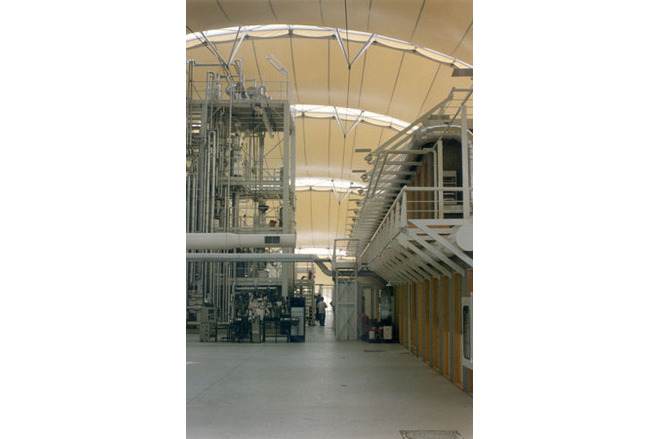
The centre consists of two areas: a technical area with pilot plants for the development of production and processing methods, and a chemical-physical area with labs for the synthesis and analysis of chemical products. The implementation of these chemical and physical largescale experiments has a varying space requirement which is predictable only with difficulty. From this fact resulted the requirement to create an open, column-free space as large as possible, which at the same time would allow for separate tests to be carried out in smaller protected units.
Concepts
Considerations with regard to the optimal shape of the hall led to an elliptical plan; a lightweight, tent-like form appeared already on the first sketches and developed to an oval shape (85 x 32 m) as one large volume, covered by a lightweight structure with a height of 15 m, supported by symmetrical lattice arches and braced by six longitudinal stabilising cables. The outline of the service installations and the pilot plants led to the choice of the arch shape as a flat basket (three-centre) arch. The maximum height of the pilot plants and the apex height of the building compliment each other. The optimal span for the roof membrane lies between 12 m and 15 m and this determined the number of arches. Aspects like the bracing of the arches, the transfer of the membrane forces and the search for a balanced design caused the architects to arrange the arch planes so that they intersect at a point which at the same time is the centre of the circle connecting the apexes of the arches.
Functions
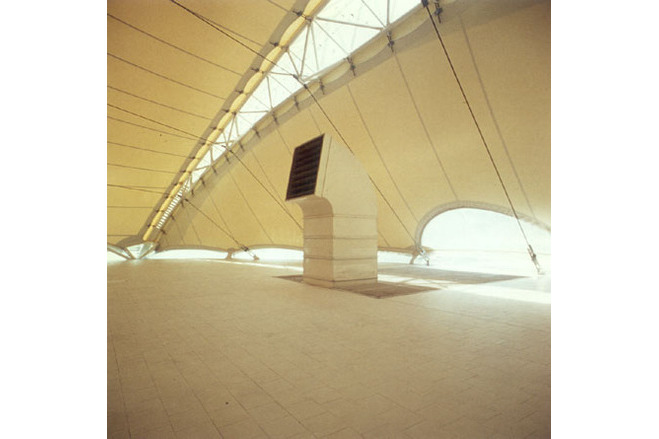
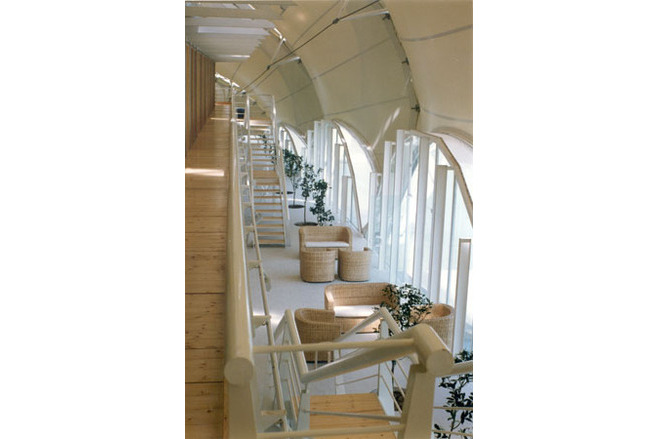
This space lit by the translucence of the roof membrane and through the glazed edge openings houses research areas. The spaces at the gable ends between the side membrane and research spaces serve as common rooms and reception areas for visitors. The floor space totals 2700m².
Structure
Arches
Six arches carry the roof membrane; they are three-chord lattice arches in the shape of a basket (three-centre) arch. Their triangular cross section varies over the arch length, with a maximum size at the apex, and tapers toward the arch support. They consist of 1764 single tubes in 441 different lengths and configurations. The arches are joined by six prestressed cables under the membrane. These stabilising cables are connected to the arches through pyramid-shaped outriggers to stay clear of the membrane curvature.
Substructure, foundations
The continous reinforced concrete ground slab with foundation pads and strips under the walls of the lab buildings and under the arches were designed for a live load of 20 kN/m². The arch feet are supported on the water level plain on reinforced concrete foundations, which are seperated structurally and visually from the ground slab.
Membrane
The membrane material of the roof is a PVC-coated polyester fabric with a tensile strength of 150 kN/m in warp and weft (fill) direction, which is equivalent to a type-4 membrane in the German classification.
The membrane is prestressed between the arches and the edge cables connecting the arch feet. The edge cables are run in membrane sleeves reinforced by webbing. At the arch supports they are connected with an adjustable connection made from a perforated flat steel plate. Along the arches the membrane is connected adjustably Through a garland cable with top and bottom cornerplates and threaded U-bolts. For waterproofing a membrane apron is connected to the roof membrane on the outside by a zipper along the bottom chord tube. The arches are covered by a transparant, prestressed plastic sheet, thus weather-protecting them economically and simultaneously keeping the arches visible and transparant membrane tensioned between roof membrane
Description of the environmental conditions
Building site - situation
The building is situated like an island in the middle of a rectangular pool and follows the outline of the foundations of a convent which once occupied this site; of the original buildings on the site a chapel and a dry-stone masonry aqueduct still exist. The artificial lake serves as a fire well and cools and animates the environment through natural evaporation and reflections. The lake, lines all around with old olive trees, is bridged over at the longitudinal sides of the building by two access ways, which form the main entrances to the building.
Services
Lighting
The truss arches are covered with a clear transparant PVC-membrane, providing additional natural lighting from above and keeping the arch structure visible at the same time. Cover strips and aprons are also made from transparant PVC-sheet. Due to the translucent membrane work is possible by day without artificial lighting. At night the building is lit by indirect halogen lighting against the roof membrane radiating from the balustrades of the lab buildings.
Ventilation, air-conditioning
For functional and safety reasons, the large air volume under the membrane roof must be airtight. By means of a simple ventilation system (on one longitudinal side the supply air comes in and on the other side the exhaust air is extracted), through shading by the roof membrane and due to the lake, an air-conditioning was not required despite the high outside temperatures. The inside temperatures correspond to ones under a free staning, naturally ventilated tent, I.e. the outside air temperature in the shade. Offices and lab spaces have independent air-conditioning.
[Soft Shells, Hans-Joachim Schock, p43-46]
General comments, links
Cost of the membrane circa 300000 lire/m2 (155 EURO/m2) in 1990.
Teil 9/21: Forschungszentrum in Venafro
Arch & Life 36/1990
Bouwen met staal
Canobbio
Verso un processo integrato
Research Laboratory Venafro, Pozzilli, Italy
Tensile Architecture in the Urban Context
Textile Components in Building Construction
Architectural Review 1992 March
Birdair Tensioned Membrane Structures
Material of the cover
-
Cable-net/Fabric/Hybrid/Foil
Cable
-
Material Fabric/Foil
Polyester
-
Material coating
PVC
Main dimensions and form
-
Covered surface (m2)
2700
-
Total length (m)
34
-
Total width (m)
85
-
Form single element
Anticlastic
Duration of use
-
Temporary or permanent structure
Temporary
-
Convertible or mobile
Convertible
-
Design lifespan in years
31-..
Involved companies
-
Architects
Samyn and Partners
Setesco
-
Engineers
IPL Ingenieurplanung Leichtbau GmbH
-
Contractors
-
Suppliers
Verseidag-Indutex GmbH
Editor
-
Editor
Marijke M. Mollaert